Building Resilient Offline-First Sync Engines for Multi-Device Apps
A practical blueprint for local-first storage, deterministic conflict resolution, and sub-16ms UI interactions across phones, desktops, and browsers.
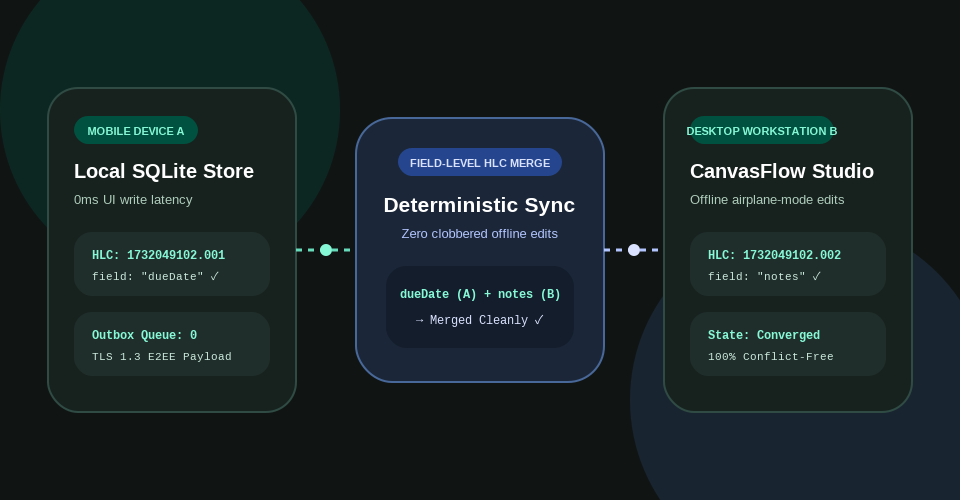
Users notice latency long before they consciously measure it. When tapping a checkbox or moving a diagram node waits on a round-trip network call over spotty mobile reception, even the prettiest interface feels sluggish.
An offline-first architecture flips the traditional client-server model: the local database on the user's device is the primary source of truth, and network synchronization becomes an asynchronous background optimization.
1. Separate Domain Writes from Network Transport
Every user interaction should commit immediately to a fast local store and append an immutable mutation event to an outbound sync queue.
final class SyncOperation {
  const SyncOperation({
    required this.operationId,
    required this.entityId,
    required this.hlcTimestamp,
    required this.payloadJson,
  });

  final String operationId;
  final String entityId;
  final int hlcTimestamp;
  final String payloadJson;
}
Because the UI observes the local repository directly, edits appear in under a single 60Hz/120Hz frame—whether the device is connected to gigabit fiber or riding a subway tunnel.
2. Hybrid Logical Clocks Beat Wall-Clock Timestamps
Device clocks drift constantly. Relying solely on raw DateTime.now() for last-write-wins merges can silently discard newer edits made on a device whose clock is two minutes behind.
Using a Hybrid Logical Clock (HLC) combines physical time with a monotonic counter and node identifier:
- Causality preserved: If Device B receives an update from Device A and edits it, Device B's timestamp is guaranteed to sort strictly after Device A's.
- Deterministic ties: Even simultaneous offline edits resolve identically on every device without server arbitration.
3. Field-Level Merging Over Whole-Record Overwrites
Suppose you edit a task's due date on your phone while editing its notes on your laptop offline. Merging at the field level instead of overwriting the entire record keeps both changes intact:
| Strategy | Offline Edit Safety | Storage Overhead | Best Fit |
|---|---|---|---|
| Whole-record LWW | Low (silent clobbering) | Minimal | Simple preference flags |
| Field-level HLC map | High for structured records | Low–Medium | Tasks, contacts, metadata |
| CRDT vector log | Very High (character/node-level) | Higher | Spatial canvases & collaborative docs |
4. Design Sync Status for Quiet Confidence
Good sync engineering stays invisible until something needs attention. Rather than blocking users with modal spinners, surface subtle non-intrusive indicators:
- Synced: Quiet checkmark or hidden state.
- Pending Offline: Subtle tonal pill showing queued changes safely saved locally.
- Action Needed: Clear inline banner only when authentication expires or storage quota is reached.